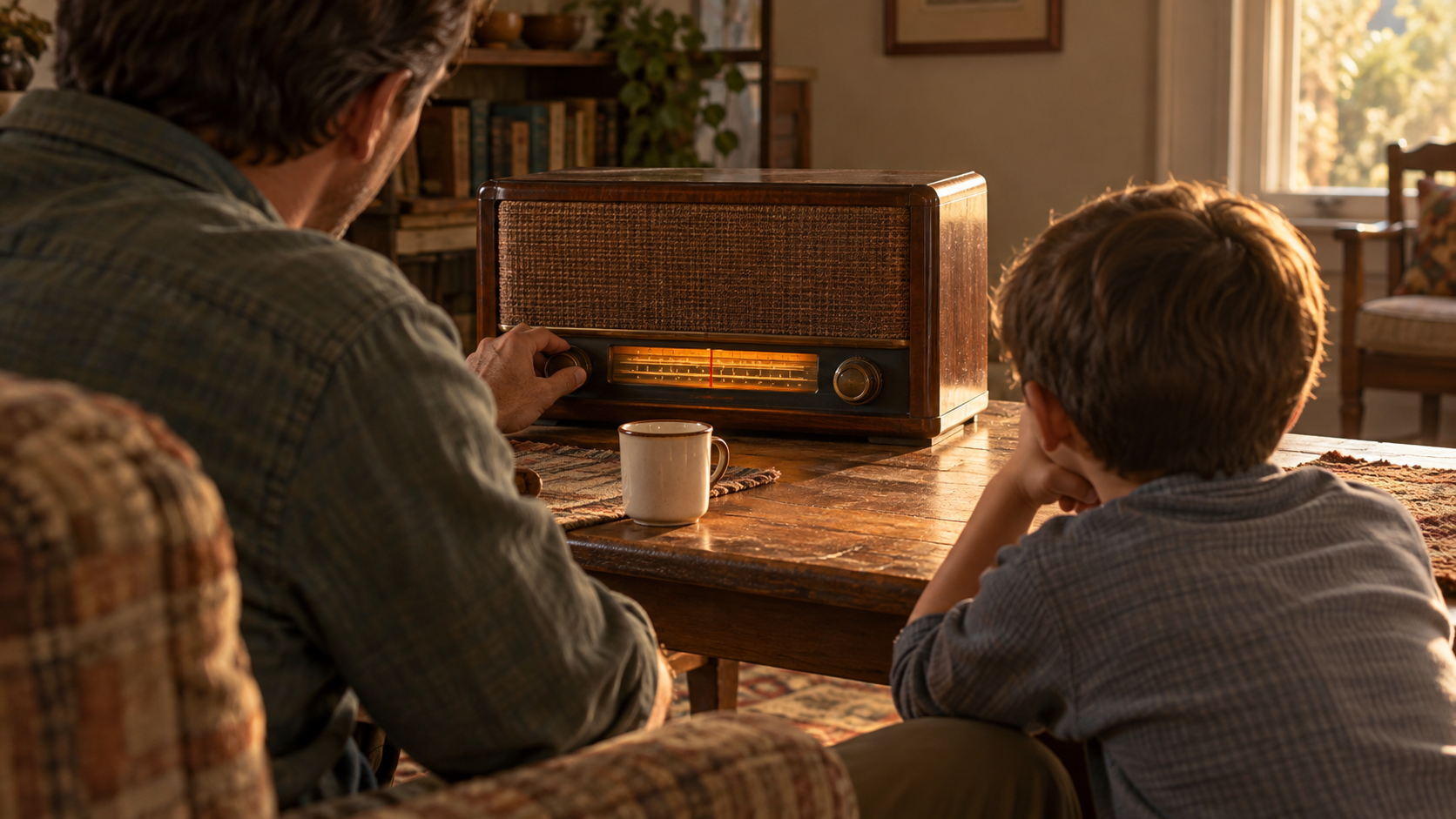
The boy turned the knob again. Still nothing.
“You’ll wear it out before you hear anything,” the man said.
The dial had lit up. Behind the glass, a thin line of orange rested over a row of numbers. The boy leaned closer, listening for a sound that might mean he had done it right.
“Is it broken?”
“Give it a second.”
The man settled into the chair beside him. He had brought his coffee in, though he usually forgot to drink it once they got talking.
“There are tubes in this one. They have to warm up.”
The boy looked at the cabinet. He had expected something bigger for a machine that needed warming.
A faint hiss came through the cloth. Then a voice, far away and a little rough at the edges.
“There you go.”
The man turned the knob slowly. For a moment two stations seemed to be arguing. Then a guitar came through, followed by a singer who sounded as though he had been awake for a long time.
The boy reached for the volume.
“Hold on. Leave it there.”
He took his hand away.
The man tapped one finger against the side of his cup. He did it so lightly that the boy could hear the fingernail but not quite follow the rhythm.
“That’s country music?”
“That’s country.”
“Why does he sound sad?”
The man listened before answering.
“Well, he’s singing about somebody who left.”
“Did somebody really leave?”
“Could have. Maybe he’s singing somebody else’s story.”
The boy considered that. It seemed like a strange job, being sad for somebody you might not even know.
“There are happy ones, too,” the man said. “You just haven’t let me get to them.”
He took a sip of coffee, made a face, and put the cup down.
“Cold?”
“Getting there.”
The singer finished a line. A fiddle answered him.
The man lifted his finger from the cup.
“Listen to that.”
The boy had been listening to the singer. He tried to find the other sound again, the one that seemed to come in from the side.
“It’s doing what he just did.”
“A little. Then it goes somewhere else.”
They waited for it to come back.
The man could have named every instrument. Sometimes he did. That afternoon he let the boy point them out, including one he got wrong, which turned into a discussion about steel guitars and why they didn’t sound like the guitar he knew.
At some point the coffee was carried away and brought back hot. The boy stayed by the radio.
He had questions about the tubes. How old were they? Did newer radios have them? Would this one quit working someday?
The man answered what he could. When he didn’t know, he said so.
Then he found another song.
Years later, the boy would remember very little about the radio’s insides. He could picture the dial and the brown cloth over the speaker. He remembered being allowed to turn the knob, and being stopped just before he turned it too far.
What stayed clearest was the voice beside him, talking about country music as though they had all afternoon.
That man was my dad, and the boy waiting for the fiddle was me.